

Africa’s Coup Belt Explained: Comparing 10 Elected Leaders with Their Junta Overthrowers

Africa’s Coup Belt Explained: Comparing 10 Elected Leaders with Their Junta Overthrowers

Jul 22, 2026 - 10:59
 1

Explore the top 10 recent military coups across Africa. Compare ousted civilian presidents with the junta leaders who seized power in Niger, Gabon, Mali, Burkina Faso, Guinea, and Sudan.


Africa’s Coup Belt: Comparing 10 Elected Presidents with the Junta Leaders Who Ousted Them

Across West and Central Africa, a rapid succession of military takeovers has reshaped the political landscape. Known as the "Coup Belt," a stretch of nations running from the Atlantic Ocean to the Red Sea has seen civilian-led democracies replaced by uniformed military rulers.

While these military takeovers share common themes such as public frustration over insecurity, economic stagnation, and political corruption each regime change carries its own unique story.

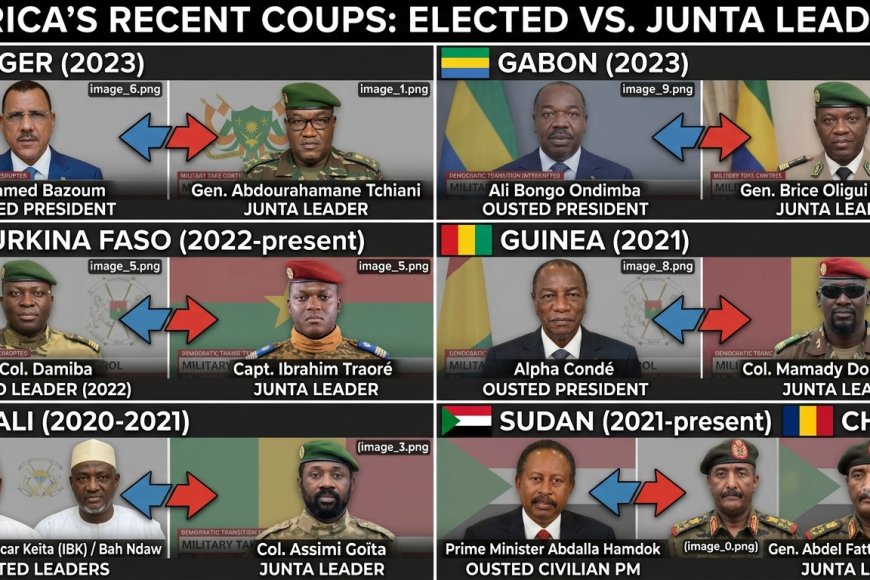
Here is a look at the top 10 recent African coups, comparing the ousted elected or transitional leaders directly with the junta commanders who took their place.

1. Niger (July 2023)

 Ousted President: Mohamed Bazoum (Elected 2021)

 Junta Leader: General Abdourahamane Tchiani

Mohamed Bazoum made history in 2021 by leading Niger's first peaceful democratic transition since independence. However, in July 2023, members of his own Presidential Guard detained him inside the presidential palace. General Tchiani declared himself head of the military council, citing deteriorating security against regional militant groups. Bazoum refused to resign and remains under house arrest despite international pressure.

2. Gabon (August 2023)

 Ousted President: Ali Bongo Ondimba (Elected 2009, re-elected 2016/2023)

 Junta Leader: General Brice Oligui Nguema

For 56 years, the Bongo family ruled Gabon. Minutes after election authorities announced Ali Bongo as the winner of a third term in a heavily contested vote, high-ranking officers appeared on television to cancel the results. General Nguema, head of the Republican Guard (and Bongo's cousin), was declared transitional president, ending the family dynasty.

3. Burkina Faso (September 2022)

 Ousted Leader: Lt. Col. Paul-Henri Sandaogo Damiba (Transitional President)

 Junta Leader: Captain Ibrahim Traoré

Just eight months after taking power himself, Damiba was ousted by junior officers within his own military. Led by the 34-year-old Captain Ibrahim Traoré, the insurgents accused Damiba of failing to curb the rampant extremist violence in the countryside. Traoré became the world's youngest head of state at the time.

4. Burkina Faso (January 2022)

 Ousted President: Roch Marc Christian Kaboré (Elected 2015, re-elected 2020)

 Junta Leader: Lt. Col. Paul-Henri Sandaogo Damiba

The Story: Elected democratically in 2015, Kaboré faced growing public discontent as armed Islamist factions gained control of nearly 40% of the country. Following a military mutiny over a lack of equipment and strategy, Lt. Col. Damiba forced Kaboré to resign and suspended the constitution.

5. Guinea (September 2021)

 Ousted President: Alpha Condé (Elected 2010, modified constitution for 3rd term in 2020)

 Junta Leader: Colonel Mamady Doumbouya

Alpha Condé was Guinea's first democratically elected president, but his decision to amend the constitution to run for a controversial third term sparked widespread anger. Colonel Doumbouya, commander of an elite special forces unit, stormed the presidential palace, arrested Condé, and promised to restore economic fairness and governance.

6. Sudan (October 2021)

 Ousted Leader: Prime Minister Abdalla Hamdok (Civilian Transitional Head)

 Junta Leader: General Abdel Fattah al-Burhan

Following the 2019 overthrow of dictator Omar al-Bashir, civilian and military leaders agreed to share power under Prime Minister Abdalla Hamdok. In October 2021, General al-Burhan dissolved the transitional government and placed Hamdok under arrest, derailing Sudan's path toward democratic civilian rule.

7. Mali (May 2021 – "Coup Within a Coup")

 Ousted Leader: Bah Ndaw (Interim Civilian President)

 Junta Leader: Colonel Assimi Goïta

After seizing power in 2020, Colonel Assimi Goïta appointed a civilian, Bah Ndaw, to lead a transitional government. However, when Ndaw announced a cabinet reshuffle that removed two influential military officers without Goïta's approval, Goïta arrested Ndaw and officially took over the presidency himself.

8. Mali (August 2020)

 Ousted President: Ibrahim Boubacar Keïta (Elected 2013, re-elected 2018)

 Junta Leader: Colonel Assimi Goïta

Months of anti-government protests filled the streets of Bamako over corruption, disputed parliamentary elections, and an escalating security crisis in northern Mali. Mutinous soldiers arrested President Keïta, who resigned on national television to avoid bloodshed.

9. Chad (April 2021 – Unconstitutional Transition)

 Predecessor: Idriss Déby Itno (Elected/Dictatorial head since 1990)

 Junta Leader: General Mahamat Idriss Déby

Hours after election results confirmed President Idriss Déby’s re-election, he was killed on the frontline against rebel forces. Instead of following the constitutional succession (where the head of parliament assumes power), the military dissolved parliament and appointed his son, General Mahamat Déby, as head of a Transitional Military Council.

10. Sudan (April 2019)

 Ousted Leader: Omar al-Bashir (In power since 1989)

 Junta Leader: General Ahmed Awad Ibn Auf / General Abdel Fattah al-Burhan

After 30 years of authoritarian rule, months of nationwide mass protests demanding economic relief forced the Sudanese military to step in. The army arrested al-Bashir and established a Transitional Military Council, kicking off a turbulent period of political instability in the country.

While international bodies like the African Union and ECOWAS have repeatedly suspended junta-led nations, military governments in the Sahel have increasingly unified, forming security pacts and distancing themselves from traditional Western allies.

Gabriel IMANIRIHO Professional Journalist dedicated to fact-checking

Africa’s Coup Belt Explained: Comparing 10 Elected Leaders with Their Junta Overthrowers

Jul 22, 2026 - 10:59
Jul 22, 2026 - 11:03
 1
Africa’s Coup Belt Explained: Comparing 10 Elected Leaders with Their Junta Overthrowers

Explore the top 10 recent military coups across Africa. Compare ousted civilian presidents with the junta leaders who seized power in Niger, Gabon, Mali, Burkina Faso, Guinea, and Sudan.


Africa’s Coup Belt: Comparing 10 Elected Presidents with the Junta Leaders Who Ousted Them

Across West and Central Africa, a rapid succession of military takeovers has reshaped the political landscape. Known as the "Coup Belt," a stretch of nations running from the Atlantic Ocean to the Red Sea has seen civilian-led democracies replaced by uniformed military rulers.

While these military takeovers share common themes such as public frustration over insecurity, economic stagnation, and political corruption each regime change carries its own unique story.

Here is a look at the top 10 recent African coups, comparing the ousted elected or transitional leaders directly with the junta commanders who took their place.

1. Niger (July 2023)

 Ousted President: Mohamed Bazoum (Elected 2021)

 Junta Leader: General Abdourahamane Tchiani

Mohamed Bazoum made history in 2021 by leading Niger's first peaceful democratic transition since independence. However, in July 2023, members of his own Presidential Guard detained him inside the presidential palace. General Tchiani declared himself head of the military council, citing deteriorating security against regional militant groups. Bazoum refused to resign and remains under house arrest despite international pressure.

2. Gabon (August 2023)

 Ousted President: Ali Bongo Ondimba (Elected 2009, re-elected 2016/2023)

 Junta Leader: General Brice Oligui Nguema

For 56 years, the Bongo family ruled Gabon. Minutes after election authorities announced Ali Bongo as the winner of a third term in a heavily contested vote, high-ranking officers appeared on television to cancel the results. General Nguema, head of the Republican Guard (and Bongo's cousin), was declared transitional president, ending the family dynasty.

3. Burkina Faso (September 2022)

 Ousted Leader: Lt. Col. Paul-Henri Sandaogo Damiba (Transitional President)

 Junta Leader: Captain Ibrahim Traoré

Just eight months after taking power himself, Damiba was ousted by junior officers within his own military. Led by the 34-year-old Captain Ibrahim Traoré, the insurgents accused Damiba of failing to curb the rampant extremist violence in the countryside. Traoré became the world's youngest head of state at the time.

4. Burkina Faso (January 2022)

 Ousted President: Roch Marc Christian Kaboré (Elected 2015, re-elected 2020)

 Junta Leader: Lt. Col. Paul-Henri Sandaogo Damiba

The Story: Elected democratically in 2015, Kaboré faced growing public discontent as armed Islamist factions gained control of nearly 40% of the country. Following a military mutiny over a lack of equipment and strategy, Lt. Col. Damiba forced Kaboré to resign and suspended the constitution.

5. Guinea (September 2021)

 Ousted President: Alpha Condé (Elected 2010, modified constitution for 3rd term in 2020)

 Junta Leader: Colonel Mamady Doumbouya

Alpha Condé was Guinea's first democratically elected president, but his decision to amend the constitution to run for a controversial third term sparked widespread anger. Colonel Doumbouya, commander of an elite special forces unit, stormed the presidential palace, arrested Condé, and promised to restore economic fairness and governance.

6. Sudan (October 2021)

 Ousted Leader: Prime Minister Abdalla Hamdok (Civilian Transitional Head)

 Junta Leader: General Abdel Fattah al-Burhan

Following the 2019 overthrow of dictator Omar al-Bashir, civilian and military leaders agreed to share power under Prime Minister Abdalla Hamdok. In October 2021, General al-Burhan dissolved the transitional government and placed Hamdok under arrest, derailing Sudan's path toward democratic civilian rule.

7. Mali (May 2021 – "Coup Within a Coup")

 Ousted Leader: Bah Ndaw (Interim Civilian President)

 Junta Leader: Colonel Assimi Goïta

After seizing power in 2020, Colonel Assimi Goïta appointed a civilian, Bah Ndaw, to lead a transitional government. However, when Ndaw announced a cabinet reshuffle that removed two influential military officers without Goïta's approval, Goïta arrested Ndaw and officially took over the presidency himself.

8. Mali (August 2020)

 Ousted President: Ibrahim Boubacar Keïta (Elected 2013, re-elected 2018)

 Junta Leader: Colonel Assimi Goïta

Months of anti-government protests filled the streets of Bamako over corruption, disputed parliamentary elections, and an escalating security crisis in northern Mali. Mutinous soldiers arrested President Keïta, who resigned on national television to avoid bloodshed.

9. Chad (April 2021 – Unconstitutional Transition)

 Predecessor: Idriss Déby Itno (Elected/Dictatorial head since 1990)

 Junta Leader: General Mahamat Idriss Déby

Hours after election results confirmed President Idriss Déby’s re-election, he was killed on the frontline against rebel forces. Instead of following the constitutional succession (where the head of parliament assumes power), the military dissolved parliament and appointed his son, General Mahamat Déby, as head of a Transitional Military Council.

10. Sudan (April 2019)

 Ousted Leader: Omar al-Bashir (In power since 1989)

 Junta Leader: General Ahmed Awad Ibn Auf / General Abdel Fattah al-Burhan

After 30 years of authoritarian rule, months of nationwide mass protests demanding economic relief forced the Sudanese military to step in. The army arrested al-Bashir and established a Transitional Military Council, kicking off a turbulent period of political instability in the country.

While international bodies like the African Union and ECOWAS have repeatedly suspended junta-led nations, military governments in the Sahel have increasingly unified, forming security pacts and distancing themselves from traditional Western allies.