

Global Development vs Food Security: Why Economic Growth is Failing Our Food Systems

Global Development vs Food Security: Why Economic Growth is Failing Our Food Systems

Jun 4, 2026 - 09:27
 0

Global economic development is rising, yet millions face severe food insecurity. Discover how the widening gap between GDP growth and climate-smart agriculture affects human welfare.

The Paradox of Progress: Why Global Development is Leaving the Dinner Table Behind

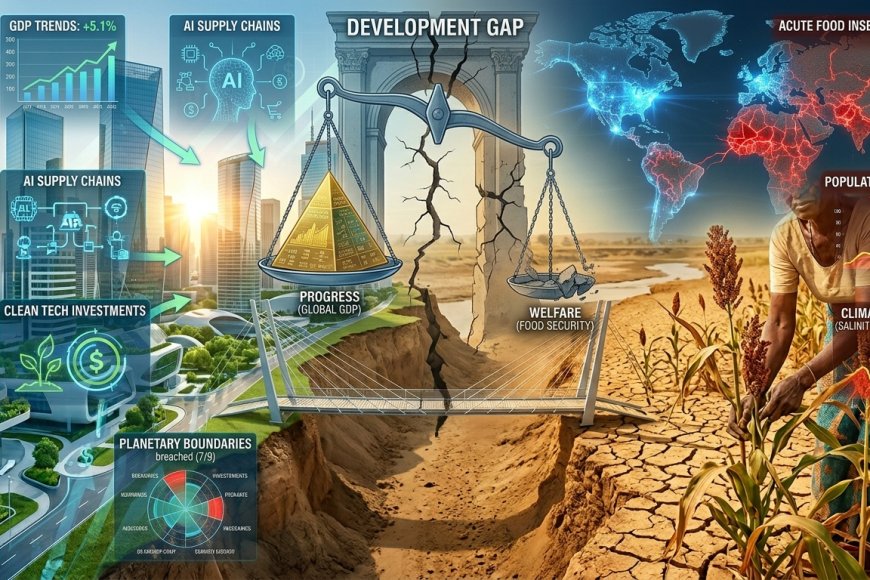
We live in an era of jaw-dropping advancement. Artificial intelligence is optimizing global supply chains, clean tech investments are surging, and global GDP figures frequently bounce back with resilience. Yet, underneath this glossy veneer of modern development lies a quiet, devastating contradiction: the world is getting better at generating wealth, but it is failing at basic human sustenance.

The gap between global economic development and food security isn't just a bump in the road; it’s a widening canyon. While urban centers transform into smart hubs, rural agricultural systems the very backbone of human survival are fracturing under the weight of climate instability, systemic inequality, and demographic pressures.

1. The Growth Illusion: Wealth vs. Welfare

For decades, standard development theory suggested a simple formula: grow the economy, and human welfare will naturally follow. But recent data shows a stark disconnect. Economic metrics can rise even as ecological and food systems collapse.

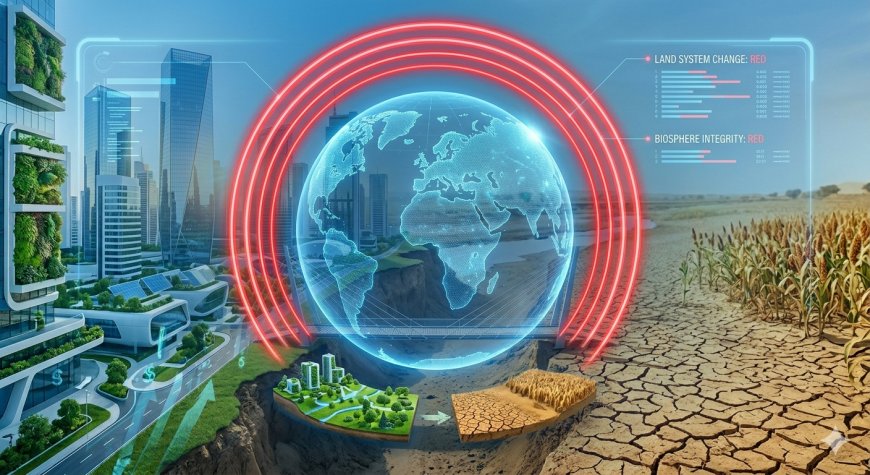
In its 2026 Trends Update, the United Nations Development Programme (UNDP) highlighted a sobering reality about our planet's baseline:

"With seven of nine planetary boundaries now breached, climate instability and ecosystem degradation are creating pressures on food security, health, land and water systems... The viability of development pathways now depends on delivering genuine ecological repair, not simply managing growth within failing Earth systems."

UNDP, "The landscape of development: UNDP trends update 2026"

When we look at regional case studies, the math of this disparity becomes alarmingly clear. For example, in Burkina Faso, the United Nations Population Fund (UNFPA) reports that despite a recovering GDP growth rate of 5.1%, climate change and regional security crises have concurrently left roughly 2.7 million people facing acute food insecurity, with over 423,000 caught in emergency conditions (UNFPA Country Programme Document for Burkina Faso, June 2026).

This is the definition of the development gap. A country can show robust percentage points on a financial spreadsheet while millions of its citizens skip meals because their fields have dried up or become unsafe to farm.

2. The Demographic Friction Point

Food security is deeply intertwined with population dynamics, a reality that traditional economic models often sideline. As the global population shifts, the strain on local food systems is felt unevenly.  

Developing nations are experiencing rapid, localized population growth, particularly in sub-Saharan Africa. Consider Mali, where the population expands at an annual rate of 3.3%, effectively putting it on track to double in just over two decades (UNFPA Country Programme Document for Mali, June 2026).

While a young, vibrant demographic is an incredible asset for future innovation, the immediate reality is a bottleneck:

The Scale Dilemma: Agricultural yields cannot keep up with exponential local demand when heavily reliant on traditional farming methods.

The Vulnerability Factor: According to UNFPA data from 2025/2026, over a third of Mali’s population required humanitarian aid, with children and women bearing the brunt of supply chain breakdowns and climate shocks.

Without transforming how food is grown and distributed, demographic growth strains the local ecosystem rather than fueling an economic dividend.

3. The Invisible Farmers: Gender and Rural Gaps
You cannot talk about the food security gap without talking about inequality. The people who are most critical to keeping humanity fed are often the ones left furthest behind by development policies.

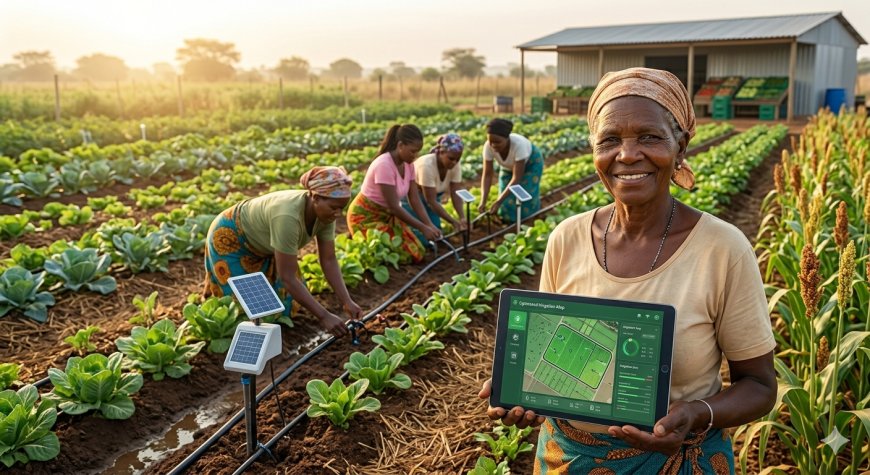
UNDP's sustainable food initiatives emphasize that Food and Agricultural Commodity Systems (FACS) are the single largest economic contributors to developing nations (UNDP, Sustainable Food Systems, 2026). Yet, rural communities specifically women frequently lack the legal, financial, and technological tools needed to adapt to a changing climate.

When development programs do intentionally target these internal structural gaps, the results are explosive. In its 2025 evaluations, UNDP noted that when rural, women-led dairy households in regions like Uzbekistan were provided with climate-smart agricultural solutions (such as tech that cuts water use by over 50%), their household incomes increased by up to 300% (UNDP Uzbekistan Annual Report, published March 2026).

This proves that the global food crisis isn't a failure of capacity; it's a failure of allocation. We have the technology to save water, restore saline soils, and boost crop yields by 25%. What we lack is the coordinated global will to transition from a mindset of "managing growth" to one of "delivering genuine ecological repair."

Moving Beyond the Gaps

If we continue to measure world development purely by financial output and technological milestones, we will continue to ignore the empty plates of millions. True development cannot coexist with chronic food insecurity.

Closing this gap requires a hard pivot in international policy. It means shifting resources away from purely corporate-centric economic growth and embedding resilience directly into the soil. We must finance localized, climate-smart agriculture, empower female rural entrepreneurs legally and financially, and acknowledge that a nation’s true development index isn't determined by its skyscrapers, but by its ability to guarantee that its next generation is reliably fed.

Sources & References:

 United Nations Development Programme (UNDP): "The landscape of development: UNDP trends update 2026" (Published February 2026) & "Sustainable Food Systems Portfolio" (2026).

 United Nations Population Fund (UNFPA): Draft Country Programme Documents for Mali and Burkina Faso, Executive Board of the UNDP/UNFPA/UNOPS (Presented June 2026).

 UNDP Bureau for Policy and Programme Support: "2025 Annual Report & Country Evaluations" (Published March 2026).

Gabriel IMANIRIHO Professional Journalist dedicated to fact-checking

Global Development vs Food Security: Why Economic Growth is Failing Our Food Systems

Jun 4, 2026 - 09:27
Jun 4, 2026 - 09:33
 0
Global Development vs Food Security: Why Economic Growth is Failing Our Food Systems

Global economic development is rising, yet millions face severe food insecurity. Discover how the widening gap between GDP growth and climate-smart agriculture affects human welfare.


The Paradox of Progress: Why Global Development is Leaving the Dinner Table Behind

We live in an era of jaw-dropping advancement. Artificial intelligence is optimizing global supply chains, clean tech investments are surging, and global GDP figures frequently bounce back with resilience. Yet, underneath this glossy veneer of modern development lies a quiet, devastating contradiction: the world is getting better at generating wealth, but it is failing at basic human sustenance.

The gap between global economic development and food security isn't just a bump in the road; it’s a widening canyon. While urban centers transform into smart hubs, rural agricultural systems the very backbone of human survival are fracturing under the weight of climate instability, systemic inequality, and demographic pressures.

1. The Growth Illusion: Wealth vs. Welfare

For decades, standard development theory suggested a simple formula: grow the economy, and human welfare will naturally follow. But recent data shows a stark disconnect. Economic metrics can rise even as ecological and food systems collapse.

In its 2026 Trends Update, the United Nations Development Programme (UNDP) highlighted a sobering reality about our planet's baseline:

"With seven of nine planetary boundaries now breached, climate instability and ecosystem degradation are creating pressures on food security, health, land and water systems... The viability of development pathways now depends on delivering genuine ecological repair, not simply managing growth within failing Earth systems."

UNDP, "The landscape of development: UNDP trends update 2026"

When we look at regional case studies, the math of this disparity becomes alarmingly clear. For example, in Burkina Faso, the United Nations Population Fund (UNFPA) reports that despite a recovering GDP growth rate of 5.1%, climate change and regional security crises have concurrently left roughly 2.7 million people facing acute food insecurity, with over 423,000 caught in emergency conditions (UNFPA Country Programme Document for Burkina Faso, June 2026).

This is the definition of the development gap. A country can show robust percentage points on a financial spreadsheet while millions of its citizens skip meals because their fields have dried up or become unsafe to farm.

2. The Demographic Friction Point

Food security is deeply intertwined with population dynamics, a reality that traditional economic models often sideline. As the global population shifts, the strain on local food systems is felt unevenly.  

Developing nations are experiencing rapid, localized population growth, particularly in sub-Saharan Africa. Consider Mali, where the population expands at an annual rate of 3.3%, effectively putting it on track to double in just over two decades (UNFPA Country Programme Document for Mali, June 2026).

While a young, vibrant demographic is an incredible asset for future innovation, the immediate reality is a bottleneck:

The Scale Dilemma: Agricultural yields cannot keep up with exponential local demand when heavily reliant on traditional farming methods.

The Vulnerability Factor: According to UNFPA data from 2025/2026, over a third of Mali’s population required humanitarian aid, with children and women bearing the brunt of supply chain breakdowns and climate shocks.

Without transforming how food is grown and distributed, demographic growth strains the local ecosystem rather than fueling an economic dividend.

3. The Invisible Farmers: Gender and Rural Gaps

You cannot talk about the food security gap without talking about inequality. The people who are most critical to keeping humanity fed are often the ones left furthest behind by development policies.

UNDP's sustainable food initiatives emphasize that Food and Agricultural Commodity Systems (FACS) are the single largest economic contributors to developing nations (UNDP, Sustainable Food Systems, 2026). Yet, rural communities specifically women frequently lack the legal, financial, and technological tools needed to adapt to a changing climate.

When development programs do intentionally target these internal structural gaps, the results are explosive. In its 2025 evaluations, UNDP noted that when rural, women-led dairy households in regions like Uzbekistan were provided with climate-smart agricultural solutions (such as tech that cuts water use by over 50%), their household incomes increased by up to 300% (UNDP Uzbekistan Annual Report, published March 2026).

This proves that the global food crisis isn't a failure of capacity; it's a failure of allocation. We have the technology to save water, restore saline soils, and boost crop yields by 25%. What we lack is the coordinated global will to transition from a mindset of "managing growth" to one of "delivering genuine ecological repair."

Moving Beyond the Gaps

If we continue to measure world development purely by financial output and technological milestones, we will continue to ignore the empty plates of millions. True development cannot coexist with chronic food insecurity.

Closing this gap requires a hard pivot in international policy. It means shifting resources away from purely corporate-centric economic growth and embedding resilience directly into the soil. We must finance localized, climate-smart agriculture, empower female rural entrepreneurs legally and financially, and acknowledge that a nation’s true development index isn't determined by its skyscrapers, but by its ability to guarantee that its next generation is reliably fed.

Sources & References:

 United Nations Development Programme (UNDP): "The landscape of development: UNDP trends update 2026" (Published February 2026) & "Sustainable Food Systems Portfolio" (2026).

 United Nations Population Fund (UNFPA): Draft Country Programme Documents for Mali and Burkina Faso, Executive Board of the UNDP/UNFPA/UNOPS (Presented June 2026).

 UNDP Bureau for Policy and Programme Support: "2025 Annual Report & Country Evaluations" (Published March 2026).